
Specialty Care
Infusion treatments, whether at home, in a healthcare clinic or other non-hospital setting, require highly trained Specialty Care nursing and pharmacy support. Trust becomes essential for these higher-risk infusion therapies that require ongoing care.

Clinical Nutrition
Nutrition plays an essential role in sustaining quality of life for those who require care for complex conditions. Pentec Health provides personalized clinical nutrition solutions and superior community-based care.

Disease States
Managing the multifaceted needs for a variety of conditions requiring clinical nutrition and specialty care therapies, services and products. This includes patients with kidney disease, kidney failure, chronic, non-healing wounds, gastrointestinal conditions, rare metabolic disorders, chronic pain, muscle spasticity or cancer within or that has metastasized in the liver.
Continuing Education
By leveraging decades of clinical expertise, we are able to successfully demonstrate our industry leadership through webinars, speaker programs and research studies. We take pride in sharing valuable insights that enhance clinician education and practice.

Patient Resources
We are committed to supporting patients by empowering them with knowledge and resources needed to navigate their healthcare journey with confidence.
Pentec Health
Pentec Health is a national leader in clinical nutrition and specialty care integrating pharmacy services with clinical excellence to enhance the complex care journey.

An innovative, patient-centric approach to intraperitoneal nutrition (IPN)
Protein-energy wasting (PEW) is one of the most common and challenging complications for individuals undergoing peritoneal dialysis (PD). Characterized by ongoing malnutrition, severe protein deficits, loss of muscle mass (sarcopenia), and declining physical strength, PEW can significantly affect a patient's daily quality of life and overall clinical outcomes.
Intraperitoneal Nutrition (IPN) has long served as an effective therapeutic intervention for PEW. By replacing a portion of dextrose in dialysate solutions with amino acids, IPN delivers crucial protein directly into the peritoneal cavity during regular dialysis exchanges. However, traditional cycler IPN formulations typically rely on high-volume (5–6 Liter) bags. For many patients, particularly those with limited physical strength, reduced mobility, or minimal home storage space, handling and storing these heavy bags can create a significant daily treatment burden that can hinder long-term therapy adherence.
To address these real-world challenges, Pentec Health clinical team members conducted a study evaluating a lower-volume approach to cycler IPN. Presented at the National Kidney Foundation (NKF) Spring Clinical Meetings, this research demonstrates how customizable, lower-volume formulations can maintain protein delivery while dramatically easing treatment demands.
Rethinking IPN: Lower volume, full protein delivery
The study evaluated an innovative IPN strategy that utilizes lower-volume (2–3L) formulations tailored to a patient's specific dialysis regimen, cycler brand, cassette configuration, and ultrafiltration (UF) goals. Rather than requiring large 6L bags that add physical strain and line priming waste, the lower-volume 3L IPN bag is integrated directly into the patient's existing cycler setup.
Key prescription advantages
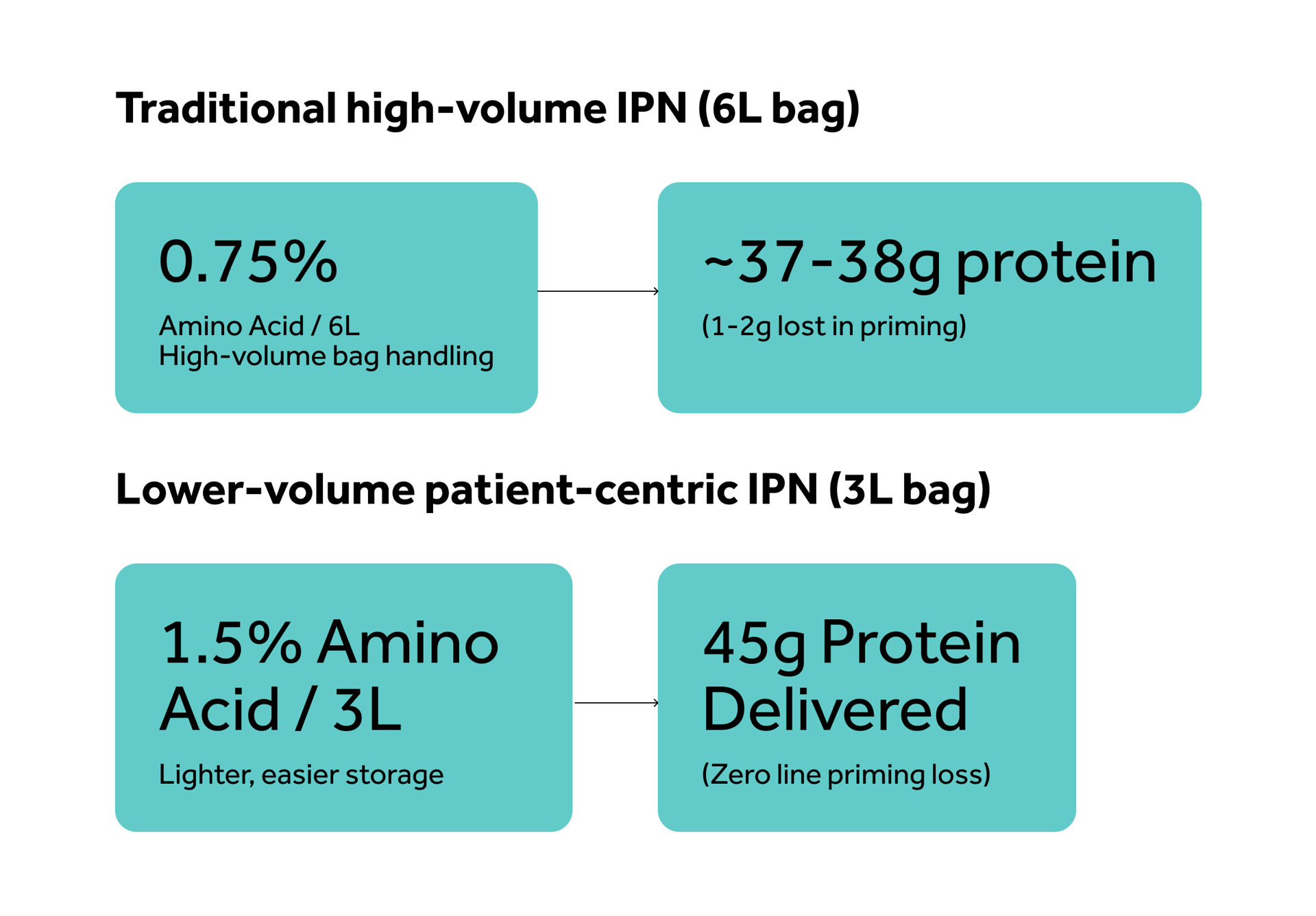
Optimized protein delivery: A 3L bag containing 1.5% amino acid delivers 45 grams of protein with zero amino acid loss in priming lines. In contrast, traditional 6L bags (0.75% amino acid) result in a 1–2g loss during line priming, delivering only 37–38g of protein.
Reduced daily physical burden: Smaller, lighter bags are easier to transport, store, and connect to cycler machines, offering crucial independence for elderly or physically frail patients.
Flexible cycler compatibility: Lower-volume formulations can be tailored to various PD cycler brands (such as the Claria cycler) and cassette types without disrupting fluid balance or ultrafiltration requirements.
Clinical results: Higher retention at six months
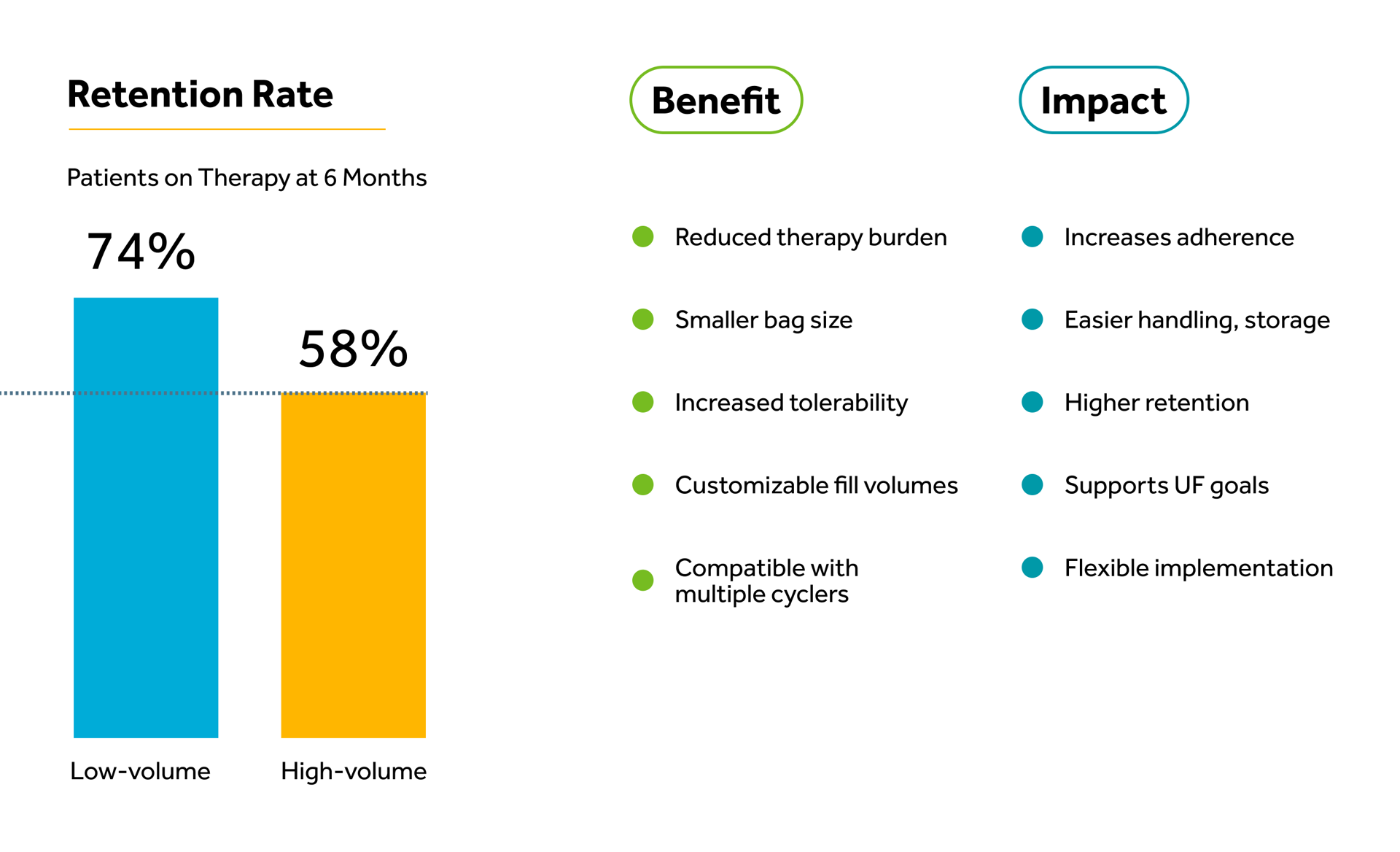
When patients find a medical regimen manageable, they are far more likely to stay on therapy. Clinical observations from Pentec Health's service highlight a significant jump in six-month patient retention rates when comparing lower-volume IPN to traditional high-volume therapy:
Lower-volume IPN retention rate: 74% at 6 months
Traditional high-volume IPN retention rate: 58% at 6 months
This 16% improvement in retention underscores the impact of patient-centric design in clinical nutrition. By matching clinical needs with real-life practicality, lower-volume IPN helps patients remain consistent with their therapy, leading to sustained nutritional status and better long-term management of PEW.
Read the full research poster
For a detailed breakdown of cycler fill protocols, osmolarity measurements, and patient prescription considerations, view the complete clinical poster presented at the National Kidney Foundation Spring Clinical Meetings here.
Explore Pentec Health's collection of research papers and posters here. You can also stay up to date on the latest developments in IDPN and IPN therapy while earning continuing education (CE) credits through our collection of past webinars.
Resources for clinicians and patients
We are committed to supporting nephrologists, dietitians, and patients with targeted clinical nutrition solutions. Explore our related resources and simplify your patient referral process using the links below:
Proudly Quality Accredited
National Quality Approval
The Joint Commission
Accredited Practice Transition
Program With Distinction
American Nurses Credentialing Center

NHIA Provider Member
National Home Infusion Association Center

By using this website you accept our privacy policy. Choose the browser data you consent to allow: